


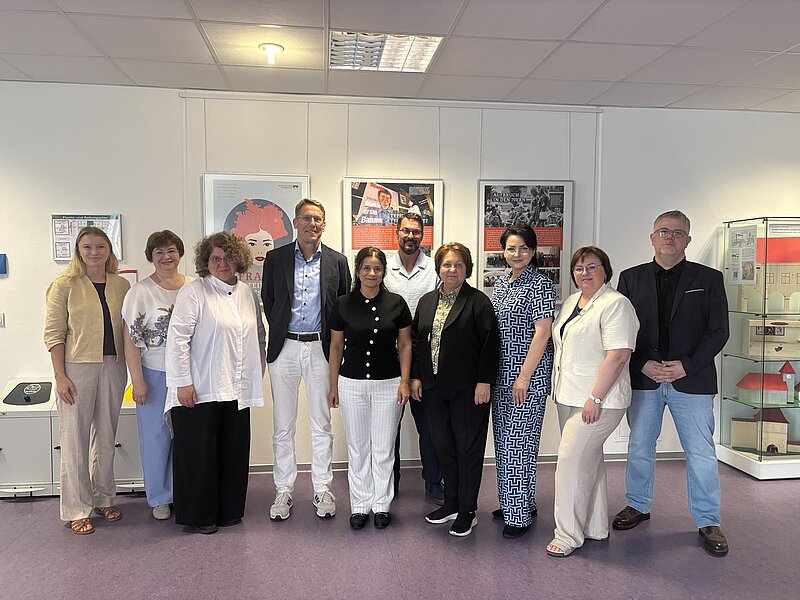
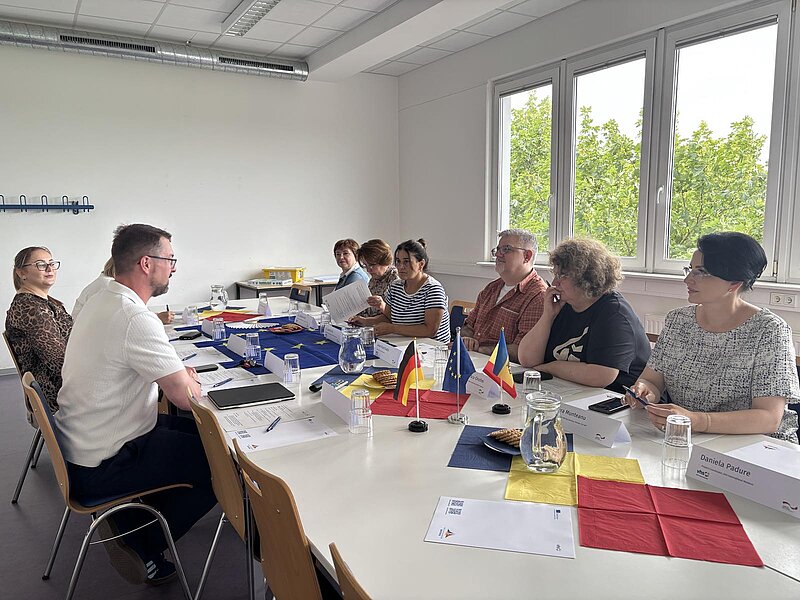
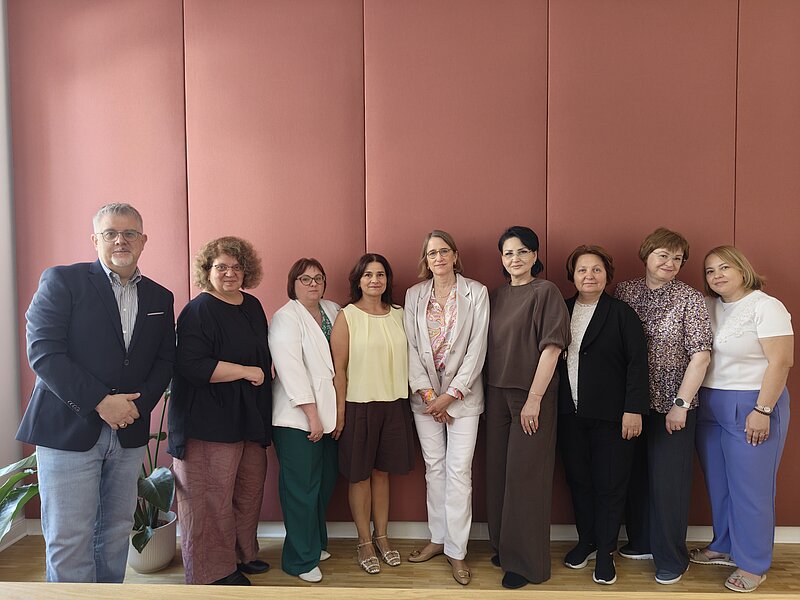
In the period 13-18 July 2026, a high-level delegation from the Republic of Moldova had a study visit to Germany, organised by DVV International in collaboration with the adult education centres in Berlin Mitte and Rostock and the UNESCO Institute for Lifelong Learning (UIL), and financially supported by the Federal Ministry for Economic Cooperation and Development (BMZ).
The goal was to learn from successful European models of adult learning, to look into possible in-country policymaking and to deepen international cooperation in this important field.
Among the Moldovan delegation were Liliana Nicolaescu-Onofrei, Chairwoman of the Committee on Culture, Education, Research, Youth, Sports and Mass Media of the Parliament of the Republic of Moldova, and Liudmila Stihi, State Secretary at the Ministry of Education and Research and other key decision-makers from the Ministry of Education and the city administration of the Moldovan capital, Chisinau.
The study visit began in Berlin, where delegates met with representatives of the DVV International. Participants exchanged experiences with DVV leadership and explored Germany's approach to lifelong learning, including policies that support adult education, community engagement and non-formal learning opportunities. Discussions focused on how adult education contributes to social cohesion, workforce development, and active citizenship.
The delegation also visited the Volkshochschule Mitte (Municipal Adult Education Centre of Berlin-Mitte), where they learned about the institution's educational programmes, management model and cooperation with local authorities. Meetings included exchanges with representatives of the Berlin Senate Department for Education and the Service Centre for Berlin's Municipal Adult Education Centres, providing valuable insights into the governance and financing of adult learning systems.
A major highlight of the study visit was the delegation's engagement with the UNESCO Institute for Lifelong Learning (UIL) in Hamburg.
The Moldovan delegation was welcomed by Isabell Kempf, Director of the UNESCO Institute for Lifelong Learning, and participated in a series of discussions focused on strengthening adult learning and education in Moldova. During the meeting, delegation members presented the current state of Adult Learning and Education (ALE) and Lifelong Learning (LLL) in the Republic of Moldova, sharing ongoing reforms, achievements, and future priorities.
UIL experts introduced international frameworks and initiatives designed to support countries in building effective lifelong learning systems. Topics included the mandate and activities of UIL, the UNESCO Global Network of Learning Cities, and capacity-building opportunities available to national and local stakeholders.
The programme also explored contemporary challenges and opportunities in adult education, including the development of digital competencies. UNESCO specialists presented initiatives such as Digital Empowerment for Lifelong Learning and Transformative Andragogy (DELTA) and programmes aimed at strengthening digital skills among adult educators and literacy practitioners.
The visit continued at Hamburg City Hall, where the delegation was received by Corinna Nienstedt, Head of the State Office within the Senate. A presentation of the UNESCO Learning City of Hamburg by Ralf Behrens, UNESCO Learning City Focal Point, and Juergen Forkel-Schubert, former Focal Point of Hanseatic Learning City (Germany), provided practical examples of how municipalities can be involved in the field of Education for Sustainable Development (ESD) and successfully integrate lifelong learning into community life.
The programme continued in Rostock, where participants visited the VHS Rostock Municipal Adult Education Centre. The director of the local adult education centre (vhs), Jörg Otto Czimzik, organised a tour through the centre facilities. Afterwords the delegates engaged in discussions with educational leaders and representatives of the Ministry of Education and Child Day Care Promotion of Mecklenburg-Western Pomerania, Thomas Jackl and Maren Akobi, director of the vhs regional association.
The exchanges covered a broad range of topics, including non-formal education; adult learning statistics and participation trends; funding mechanisms for adult education; teacher recruitment and professional development; community-based learning initiatives.
An additional highlight was the presentation of the activities of the Diaspora Moldova Association by Marcela Macaru, demonstrating how educational initiatives can strengthen connections between Moldova and its diaspora communities abroad.
The study visit provided an important platform for exchanging knowledge, building partnerships and identifying innovative solutions that can support the ongoing development of adult education in Moldova.
The insights gained are particularly significant considering the Republic of Moldova’s ongoing EU accession process and the reforms of local government structures. The experience highlighted the growing international recognition of Moldova's efforts in the field of adult education and reinforced the shared vision of creating accessible learning opportunities for people of all ages, helping to build a more inclusive, skilled and resilient society.