


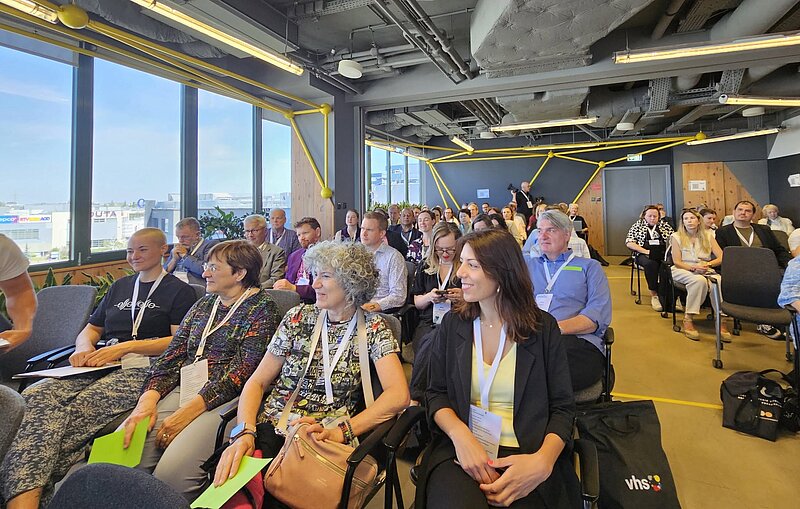
On June 9-10, the European Association for the Education of Adults (EAEA) held the General Assembly and the Annual Conference in Warsaw, bringing together adult learning and education (ALE) professionals, policymakers, researchers, and civil society representatives from across Europe. Under the main theme of resilience and community-building in adult learning and education, the event provided a platform to discuss the future of lifelong learning and the role of the sector in responding to the most acute challenges.
Shaping the Future of EAEA
The event opened with welcome remarks from EAEA President Lauri Tuomi, EAEA Board Member Anna Skocz, and moderator Greta Pelucco.
During the General Assembly, members reviewed and approved the key governance documents, including the activity and financial reports, while discussing priorities for the coming year. The event also included the official welcome of the new EAEA members. Worth mentioning that this year, one more Ukrainian organization, the Public Union “All-Ukrainian Association of Guides”, joined EAEA.
One of the central events of the first day was the presentation of the draft of the new EAEA Strategy, which has been under development for more than six months. As part of a series of interactive dialogue sessions, participants shared their perspectives on four strategic areas: advocacy and policy, capacity building for member organizations, partnerships, and internal governance. The discussions will continue online in a working format. These discussions highlighted the importance of strengthening the voice of adult learning at both European and national levels while ensuring that EAEA remains a democratic, transparent, and resilient network.
Celebrating Innovation in Adult Learning
The evening programme featured the prestigious Grundtvig Award Ceremony, which recognises outstanding projects in adult learning and education. This year's theme, "Resilience and Community-Building in Adult Learning and Education," showcased initiatives that help individuals and communities creatively respond to uncertainty, crisis, and change.
The award celebrated projects that demonstrated how adult education can foster solidarity, strengthen social cohesion, and empower people not only to cope with challenges but also to thrive in difficult circumstances.
This year, projects in national and transnational categories have been rewarded. In the national category, the project Izmir Citizens' Assembly for Climate (Yuva Association, Türkiye) won. Its aim was to connect citizens to discuss, learn, and directly contribute to local climate policy through participatory democracy and adult education. In the transnational category, the victory gained “Developing volunteering as a part of individual learning path”, VOLUGRAM (Tartu Vocational College, Estonia and partners), which promoted volunteering as a flexible learning pathway, establishing inclusive community networks connecting culture with lifelong learning across European regions.
Adult Education as a Driver of Resilience
The second conference day focused on the connection between personal resilience and community resilience. In her keynote address, Professor Alicja Gałązka of the University of Silesia explored how adult education can create reflective and participatory learning environments that support both individual development and collective wellbeing.
The keynote emphasised that resilience should not be understood solely as an individual capacity. Instead, adult learning can help build stronger communities by encouraging dialogue, participation, and mutual support in times of rapid social change.
Learning from Experience in Times of Crisis
A panel discussion on resilient communities brought together experts from the fields of human rights and adult education. In particular, the director of DVV International in Ukraine and Board Member of EAEA, Oleg Smirnov, together with colleagues from the EAEA Board and other European institutions, shared experiences from diverse and challenging contexts. In particular, speakers mentioned various examples of resilience in the Ukrainian communities. The discussion highlighted the critical role of adult learning in supporting democratic participation, protecting human rights, and strengthening social cohesion during periods of uncertainty, war, and crisis.
Co-Creating Solutions for the Better Future
The conference concluded with a series of practical workshops addressing some of the most pressing issues facing the sector. Topics included supporting educators in challenging democratic environments, preparing communities for global challenges, promoting wellbeing in organisational culture, ensuring quality in adult education, fostering inclusive multilingual learning spaces, and exploring the transformative power of education in closed environments.
One of the workshops, "Be Ready: City on the Edge”, organised by the Ukrainian business World of Communities and DVV International, attracted considerable interest, with many participants gathering around the two game tables. In fact, significantly more people decided to try the game than had originally registered for the activity. It provided a safe learning space to explore decision-making in complex environments and to understand how different sectors and resources interact within a community system. The session contributed to strengthening civic competencies, supporting lifelong learning, and encouraging cross-sector cooperation.
Through collaborative dialogue and knowledge exchange, participants developed ideas and practical approaches for strengthening resilience across adult learning systems and organisations.
Looking Ahead
The EAEA Annual Conference once again demonstrated the strength and diversity of the European adult learning community. As societies continue to face complex challenges, adult education remains a powerful tool for building resilience, fostering inclusion, and creating stronger, more connected communities.
We are grateful for the opportunity to contribute to these discussions and look forward to applying the gained insights and findings in our ongoing work to promote lifelong learning and active citizenship.